

- A new White Coat Waste (WCW) investigation has uncovered a $368,626 Food and Drug Administration (FDA) purchase order issued on August 31, 2026, to buy baboons for whooping cough experiments, despite HHS Secretary Robert F. Kennedy Jr.’s pledge to end primate testing.
- Federal records state that the FDA sought 20 baboons for pertussis infection and vaccination studies at its Maryland primate laboratory.
- An active FDA protocol allows experimenters to inject up to 48 baboons with experimental vaccines or antibodies—or leave them untreated—before deliberately infecting them with whooping cough bacteria.
- Under the protocol, bacteria are pumped into the baboons’ windpipes and noses, potentially causing violent coughing, vomiting, breathing problems, fever, weight loss, and weeks of illness.
- WCW previously shut down the FDA’s largest primate laboratory, slashed the agency’s monkey testing by 63 percent, and secured its first lab-animal retirement policy.
- WCW has carried this momentum across the federal government, leading the Department of Veterans Affairs to eliminate all of its primate laboratories and the Centers for Disease Control and Prevention to announce the shutdown of its monkey labs and retirement of the survivors to sanctuaries.
The Food and Drug Administration (FDA) is doubling down on monkey business—and breaking HHS Secretary Robert F. Kennedy Jr.’s pledge to end primate testing.
A new White Coat Waste (WCW) investigation has uncovered a $368,626 FDA purchase order, issued on August 31, 2026, to buy baboons for experiments involving pertussis—the bacteria that causes whooping cough.
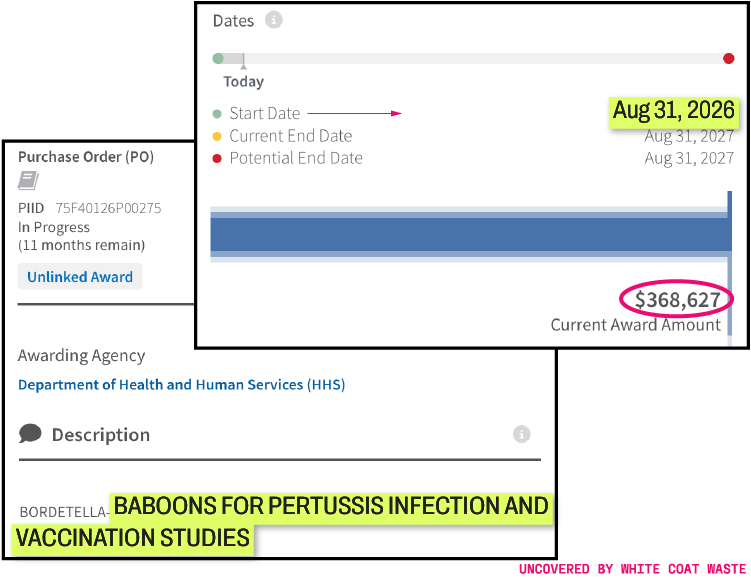

In other words, taxpayers are being forced to spend more than $368,000 to buy young baboons who will be used in experiments designed to make them sick.
The FDA laboratory has an active animal-testing protocol authorizing whooping cough experiments on up to 48 baboons. According to records obtained by WCW, experimenters divide the baboons into groups that receive experimental vaccines, antibodies, or no protection at all. They then deliberately infect the animals with pertussis bacteria by pumping it directly into their windpipes and noses.
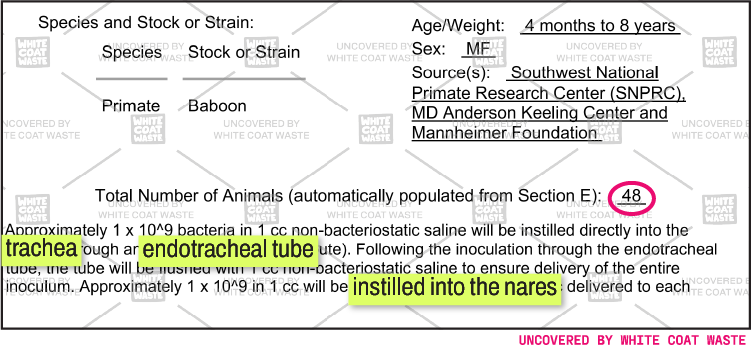
The infected baboons may endure violent coughing fits, vomiting, difficulty breathing, fever, weight loss, nasal discharge, reduced activity, and weeks of illness. Throughout the experiments, researchers repeatedly collect blood and swab the baboons’ noses and throats while tracking how sick they become. Some are ultimately killed and dissected so their windpipes, lungs, and lymph nodes can be collected.

The FDA’s latest purchase stands in stark contrast to the progress WCW has already driven at the agency.
In 2018, following pressure from WCW, the FDA canceled nicotine-addiction experiments on baby monkeys and retired the survivors to a sanctuary.
WCW kept the pressure on and subsequently shut down the FDA’s largest primate laboratory and led the advocacy and lobbying campaign that slashed the agency’s overall primate testing by 63 percent.
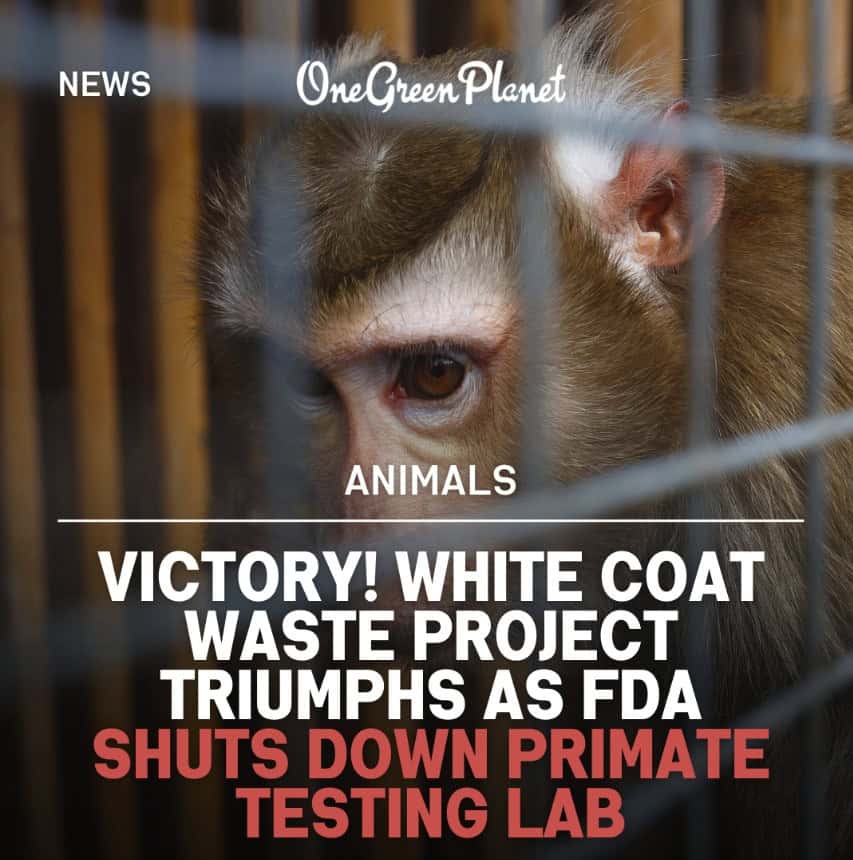
WCW also compelled the FDA to enact its first-ever agency-wide lab animal retirement policy, allowing monkeys and other animals who survive experiments to be relocated to rescues and sanctuaries.
The WCW policy victory has saved tax dollars and animals’ lives. Last year, the FDA retired several baboons from its Maryland lab to a sanctuary.
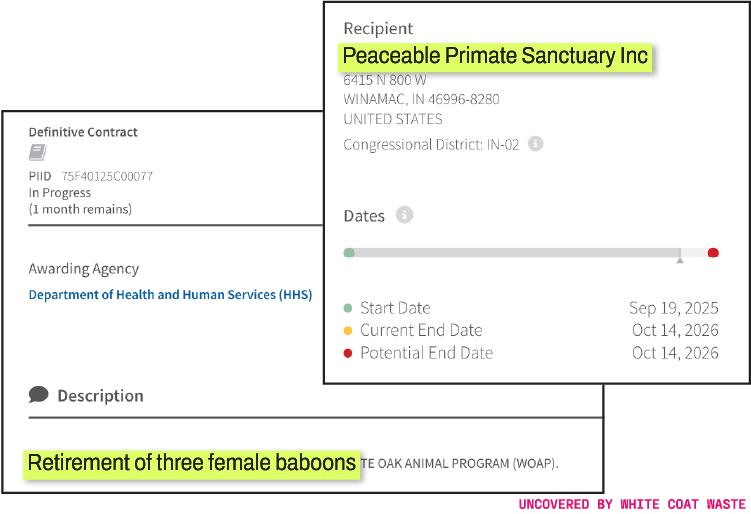
WCW’s momentum against taxpayer-funded monkey experimentation has spread across federal agencies.
In 2025, following years of WCW investigations and advocacy, the Department of Veterans Affairs became the first federal agency to eliminate all primate laboratories, and the Centers for Disease Control and Prevention announced that it was shutting down its own monkey laboratories, retiring survivors to sanctuaries.
Yet now, the FDA is spending another $368,626 to buy young baboons for painful and deadly experiments.
We’ve defeated the FDA’s monkey business before, and we can do it again.
