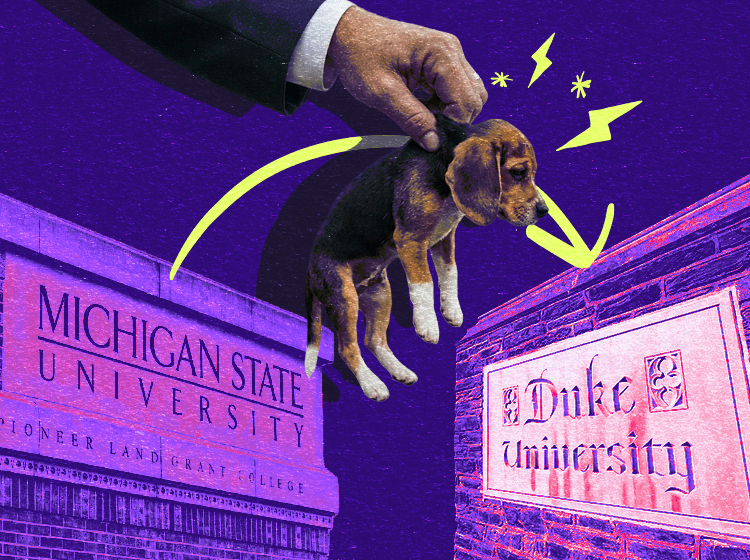
- Records obtained by White Coat Waste (WCW) expose dogs shipped from Michigan State University (MSU) to Duke University, where a National Institutes of Health (NIH)-funded project calls for invasive experiments on 12 dogs bred to have glycogen storage disease type IIIa, which damages the liver and muscles.
- NIH has awarded Duke $3,328,287 for the project, including $1,273,949 under U.S. Department of Health and Human Services (HHS) Secretary Robert F. Kennedy Jr. — another receipt for WCW’s MAHA Betrayed report showing continued spending despite his pledge to reduce animal testing.
- WCW obtained records documenting dogs shipped from MSU to Duke in 2021 and 2024, including puppies as young as 2 months old.
- MSU’s taxpayer-funded colonies breeding dogs with glycogen storage disease and beagles with blinding eye disorders, which we’ve uncovered before, are among the operations highlighted in our Pet Profiteers report on the pipeline supplying pets to laboratories.
- In Congress, WCW is pushing provisions in pending spending bills and the Farm Bill to defund dog and cat labs, and backing the bipartisan PUPPS and COMPACT Acts to end taxpayer-funded dog and cat testing.
Taxpayers are paying for both ends of a dog experimentation pipeline: one university breeds dogs to be sick, and another cuts them open and kills them.
Records obtained by White Coat Waste (WCW) expose how Michigan State University (MSU) shipped dogs to Duke University, where the National Institutes of Health (NIH) is funding experiments on dogs bred to suffer from glycogen storage disease type IIIa, a disorder that can cause progressive liver and muscle damage.

The Duke grant, R01AR079572, has received $3,328,287 from NIH, which includes $1,273,949 awarded under U.S. Department of Health and Human Services (HHS) Secretary Robert F. Kennedy Jr.
The grant is included in MAHA Betrayed, WCW’s investigation exposing more than $225 million in NIH funding supporting dog and cat experiments since RFK took office. RFK promised to reduce animal testing, but these records provide another receipt showing taxpayers are still being forced to fund deadly dog testing operations.

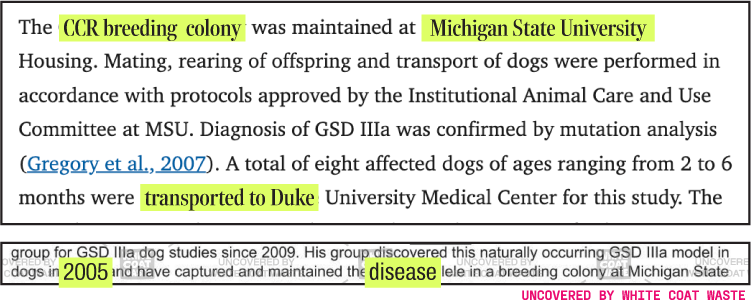
Grant application records describe a dog colony maintained at MSU with Duke’s financial support through the NIH grant. The grant budget sets aside $437,840 in taxpayer money for the dogs, including breeding at MSU and shipping them to Duke for experiments.
Taxpayers cover the whole route, from the breeding colony to the lab.

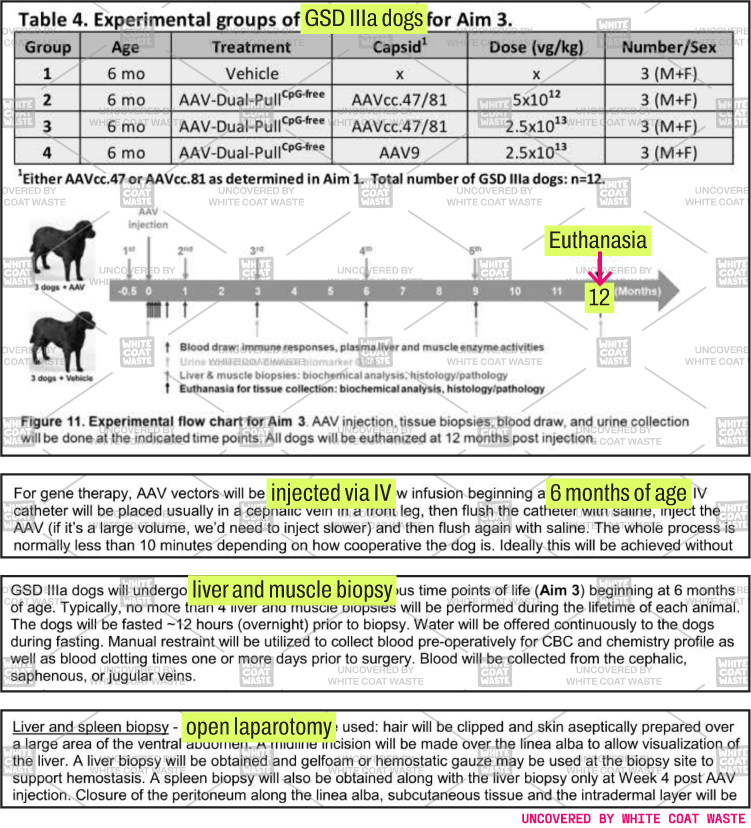
The application calls for 12 dogs to receive experimental gene therapy intravenously at 6 months old, followed by repeated blood draws and biopsies of their liver, spleen, and muscles. To collect liver and spleen samples, experimenters plan to surgically cut open the dogs’ abdomens.
After 12 months of testing, all 12 dogs are to be killed.
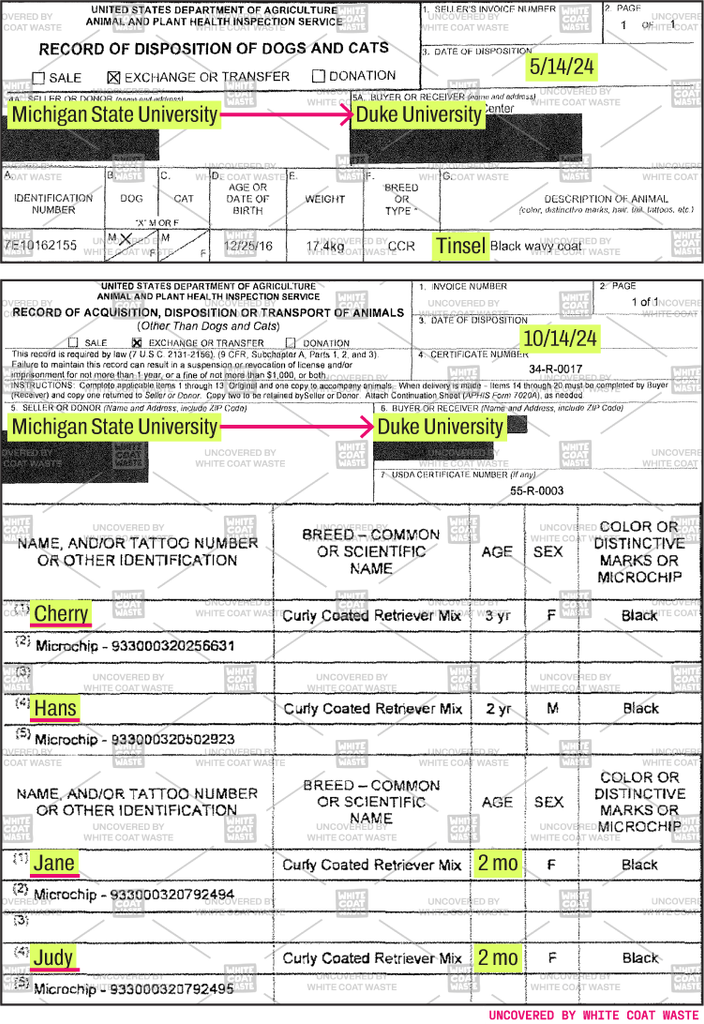
WCW also obtained health certificates and disposition records documenting dogs shipped between these institutions.
In May 2024, MSU shipped Tinsel, a male curly-coated retriever mix born on Christmas Day, to Duke. In October 2024, MSU shipped four more curly-coated retriever mixes: Cherry, 3; Hans, 2; and Jane and Judy, both just 2 months old.
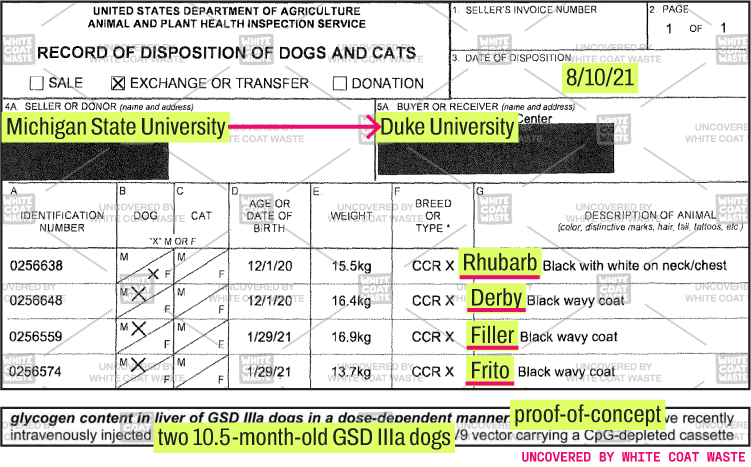
MSU has been providing dogs to Duke for experiments for years.
Additional certificates and disposition records show that MSU shipped four other dogs to Duke in August 2021: Rhubarb, Derby, Filer, and Frito. The grant records describe a “proof-of-concept” test on two dogs with the disease, done before the current grant began in 2022.
Published studies from 2012 and 2016 also describe experiments on curly-coated retrievers with glycogen storage disease type IIIa, further documenting MSU’s history of supplying these dogs to Duke for experimentation. The colony traces back to 2005, when the disease was first identified in these dogs.
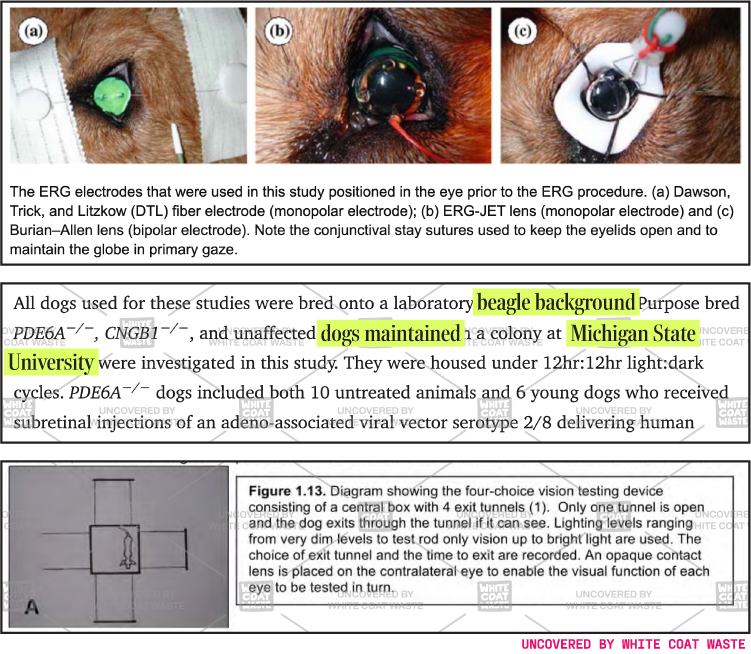
This isn’t MSU’s only dog pipeline. Our 2024 investigation uncovered more than $8.5 million in NIH funding since 2018 for an MSU colony that breeds beagles with severe vision disorders for eyeball injections and other experiments.
Our new Pet Profiteers report follows the money further: at least a dozen active university breeding colonies backed by an estimated $163 million in taxpayer-funded awards as of May 2026.

We’re going after the taxpayer-funded pipeline that breeds dogs and ships them into deadly experiments. WCW investigations follow the money from breeders to laboratories — and drive congressional action to cut it off.
Our provisions to cut funding for dog and cat laboratories are in pending spending bills, and we’re pushing to defund maximum-pain experiments on dogs and cats in the Farm Bill. WCW also backed the bipartisan PUPPS and COMPACT Acts, which would prohibit breeding dogs for experiments, end NIH and other HHS funding for dog and cat testing, and promote retirement into loving homes.