- A new White Coat Waste (WCW) investigation has uncovered a taxpayer-funded axolotl breeding colony at the University of Kentucky that supplies animals to laboratories nationwide and around the world.
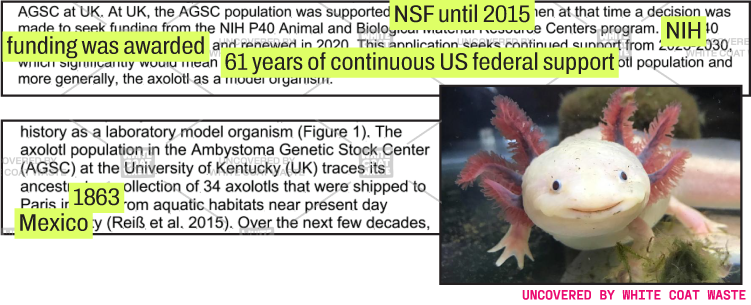
- The colony has received more than 61 years of continuous federal support totaling at least $20.3 million from the National Institutes of Health (NIH) and National Science Foundation (NSF).
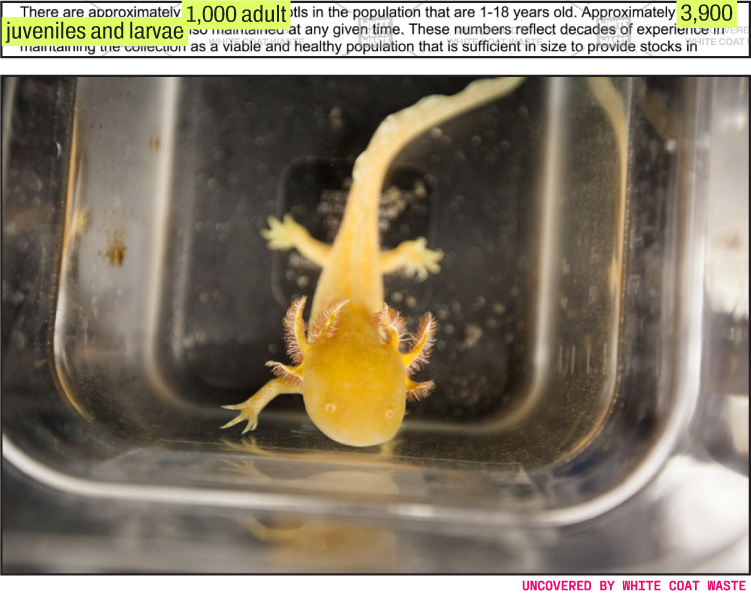
- Records exclusively obtained by WCW through the Freedom of Information Act (FOIA) describe approximately 1,000 adult axolotls and nearly 4,000 juveniles and larvae maintained to supply experiments.
- NIH and NSF have provided millions more for experiments involving limb amputations, nerve injuries, implanted electrodes, drug injections, and killing at Harvard University, Northeastern University, and the University of Massachusetts.
- WCW uncovered failures by Harvard and Northeastern to disclose taxpayer funding for their NIH-funded axolotl experiments, prompting a formal complaint over federal transparency violations.
- WCW’s years-long campaign exposing federal transparency violations at taxpayer-funded animal laboratories has prompted formal complaints, a GAO review, policy changes, and bipartisan legislation to strengthen oversight.
- This investigation is part of WCW’s new Wildlife Waste campaign exposing taxpayer-funded experimentation on wild animals, including coyotes, vipers, armadillos, and more.
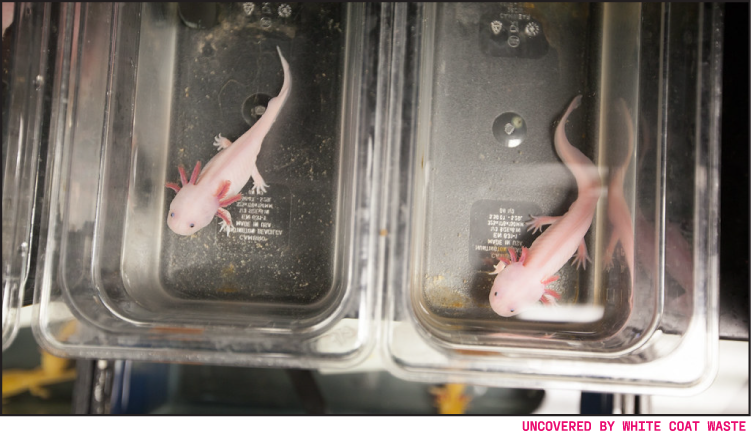
Timeline
When were the latest axolotl experiment funding awards, transparency violations, and developments in White Coat Waste’s (WCW) investigation?
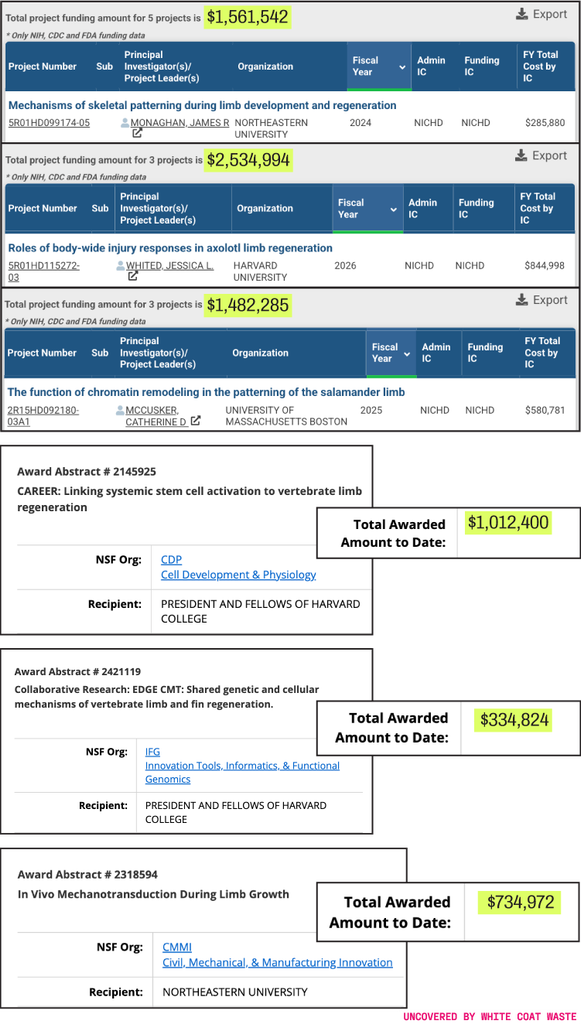
March 28, 2024: National Institutes of Health (NIH) awards Northeastern University $285,880 under grant R01HD099174, bringing the grant’s total funding to $1,561,542.
August 14, 2024: National Science Foundation (NSF) awards Northeastern $110,000 under grant 2318594 for axolotl experiments, bringing the grant’s total funding to $734,972.
June 10, 2025: Northeastern publicizes taxpayer-funded axolotl amputation experiments without disclosing the funding amount, violating federal transparency law.
July 22, 2025: NIH awards the University of Massachusetts Boston (UMass Boston) $580,781 under grant R15HD092180, bringing the grant’s total funding to $1,482,285.
October 10, 2025: WCW submits Freedom of Information Act (FOIA) requests to NIH for records on four grants supporting axolotl experiments or breeding: Northeastern’s R01HD099174, Harvard University’s R01HD115272, UMass Boston’s R15HD092180, and the University of Kentucky’s P40OD019794.
November 4, 2025: Harvard publicizes taxpayer-funded axolotl amputation experiments without disclosing the funding amount, violating federal transparency law.
December 29, 2025: NIH provides WCW with records for the Northeastern, Harvard, and UMass Boston grants.
January 7, 2026: NSF awards Harvard $200,000 under grant 2145925 for axolotl experiments, bringing the grant’s total funding to $1,012,400.
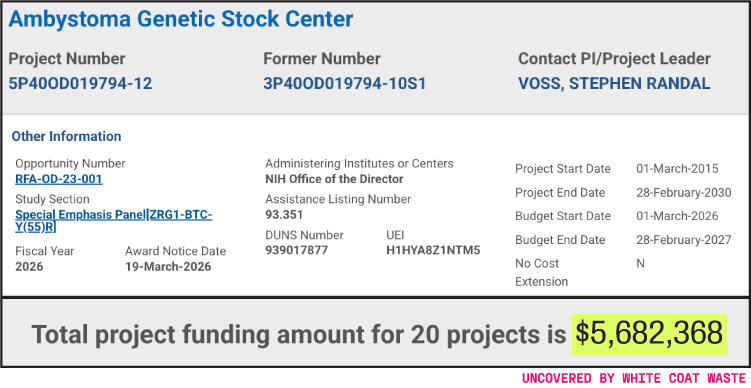
March 19, 2026: NIH awards the University of Kentucky $611,175 under grant P40OD019794 for its axolotl breeding colony, bringing the grant’s total funding to $5,682,368.
March 23, 2026: NIH awards Harvard $844,998 under grant R01HD115272, bringing the grant’s total funding to $2,534,994.
July 1, 2026: NIH provides WCW with records for the University of Kentucky’s axolotl breeding colony grant.
September 4, 2026: NSF awards Harvard $83,706 under grant 2421119 for axolotl experiments, bringing the grant’s total funding to $334,824.
November 19, 2026: WCW files a formal complaint with NIH over Harvard’s and Northeastern’s federal transparency law violations.
WCW’s recent investigations exposed taxpayer-funded wildlife experiments: the U.S. Department of Agriculture (USDA) captures and breeds coyotes, NIH funds a viper lab that captures wild snakes for venom extraction, and the National Hansen’s Disease Program acquires wild-caught armadillos for leprosy experiments.
Now, WCW is exposing a taxpayer-funded breeding operation that supplies axolotls to laboratories worldwide for invasive experiments. The colony’s origins trace back to wild axolotls captured in Mexico more than 160 years ago.
Taxpayer Funding for Axolotl Breeding
How much taxpayer money has supported the axolotl breeding colony?
At the center of this taxpayer-funded pipeline is the Ambystoma Genetic Stock Center (AGSC), a captive axolotl breeding colony currently located at the University of Kentucky. The captive breeding colony has received more than 61 years of continuous support from the NIH and NSF, totaling at least $20.3 million.
The colony continues to receive taxpayer support through an active NIH grant that has already cost taxpayers more than $5.6 million and is scheduled to run through at least 2030.
Inside the Axolotl Pipeline
How many axolotls does the colony maintain, and where are they sent?
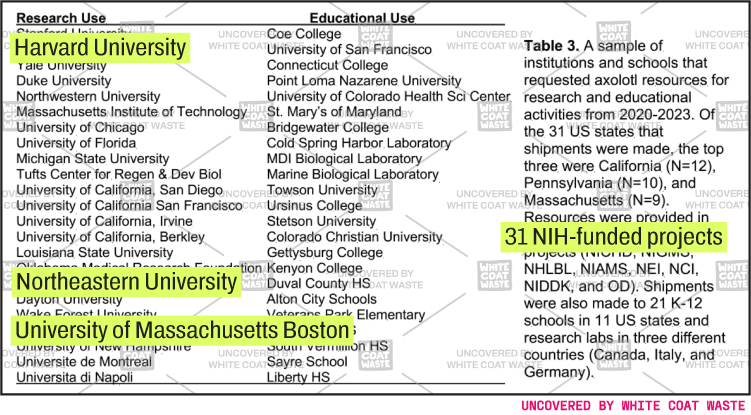
FOIA records obtained by WCW reveal that the colony maintains approximately 1,000 adult axolotls and nearly 4,000 juveniles and larvae, supplying animals to laboratories across the nation and around the world.
From 2020 to 2023 alone, the center supplied axolotls for 31 NIH-funded projects, including experiments at Harvard, Northeastern, UMass Boston, and many others.
Amputation and Other Axolotl Experiments
What taxpayer-funded experiments are performed on the axolotls?
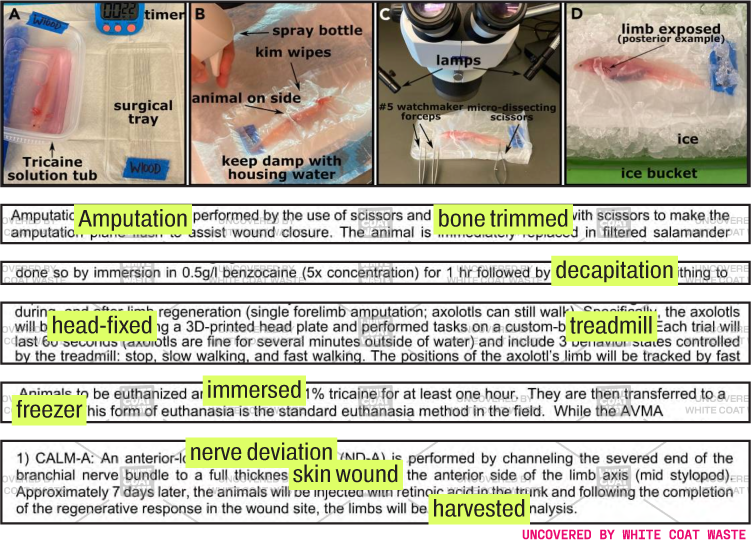
Additional FOIA records obtained by WCW found that Harvard, Northeastern, and UMass Boston are subjecting axolotls to cruel experiments involving limb amputations, bone trimming, severed nerves, implanted electrodes, drug injections, deliberate skin wounds, forced treadmill tests, and ultimately death by overdose or chemical immersion followed by decapitation or freezing.
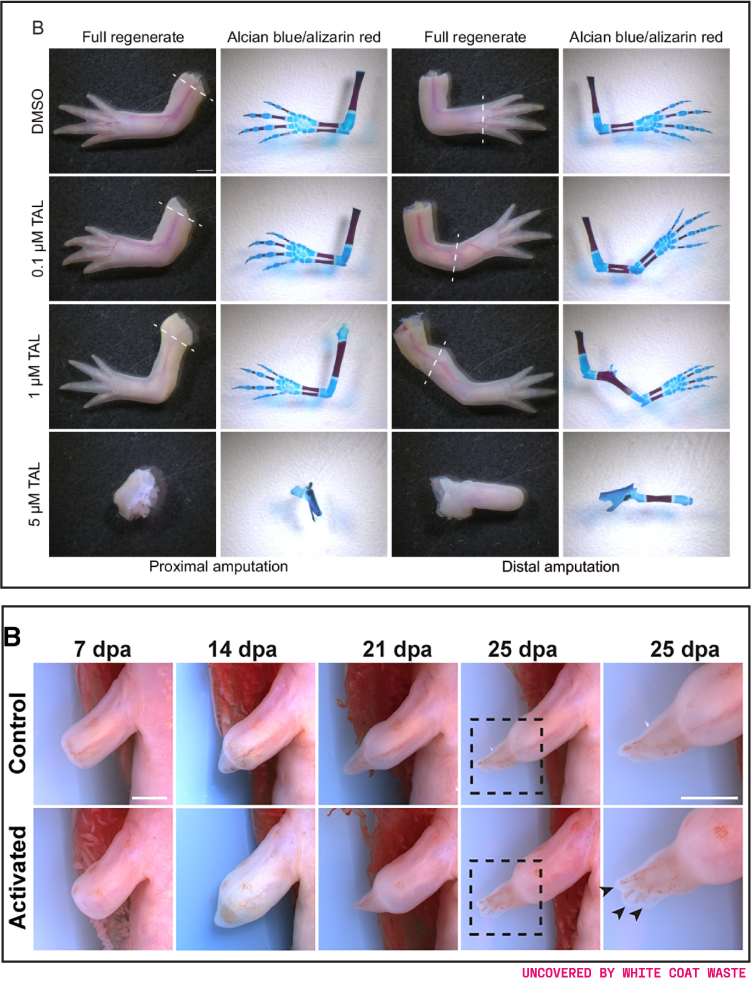
Together, these experiments have received over $5 million in NIH funding, while the same laboratories also hold $2 million in active NSF grants for additional axolotl testing.
Confinement, Pain, and Killing
What do records reveal about how axolotls are housed and killed?
Unlike dogs, cats, monkeys, and many other laboratory animals, axolotls are excluded from the Animal Welfare Act, meaning these federally funded laboratories are not subject to USDA inspections or the law’s animal care standards.
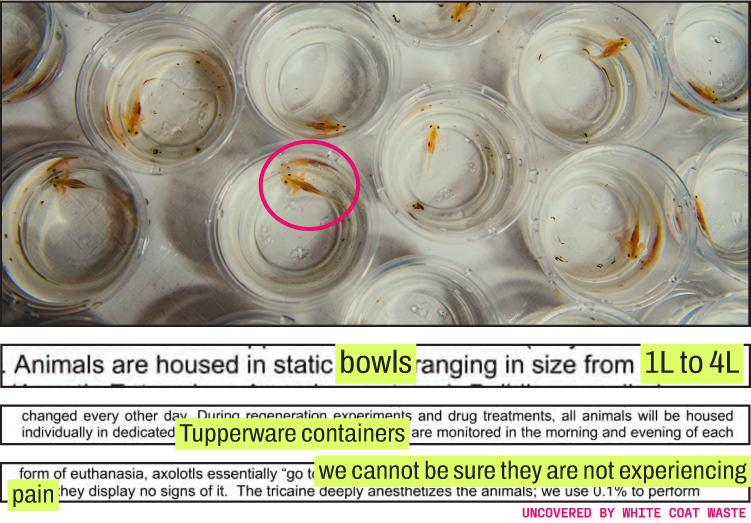
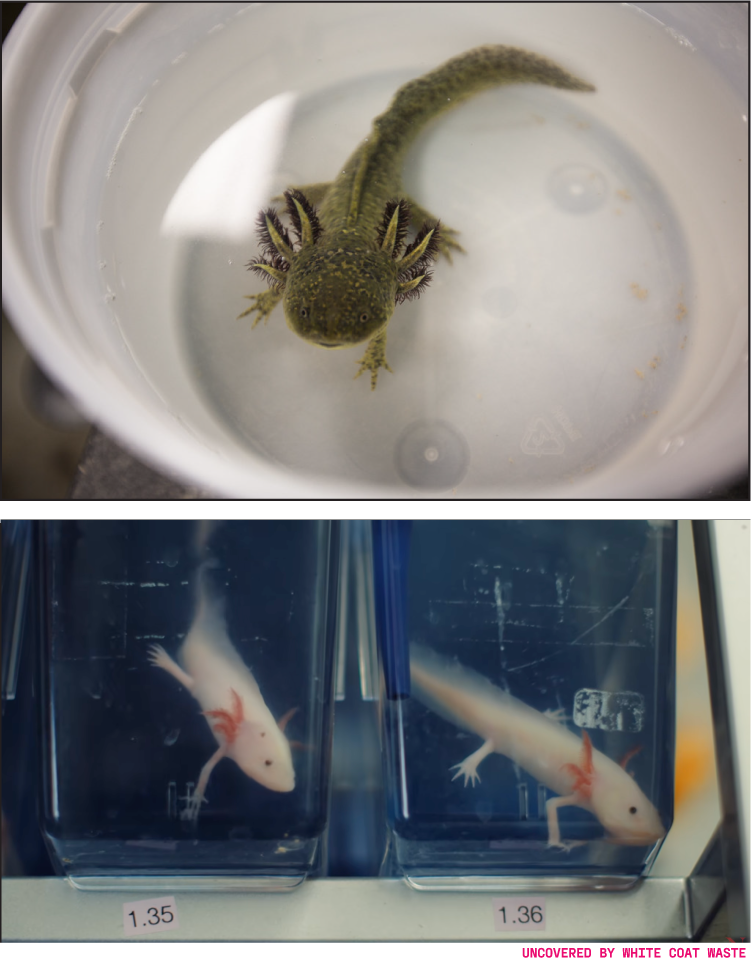
Laboratory records describe some axolotls housed in small 1- to 4-liter bowls and Tupperware containers. Experimenters also concede they “cannot be sure” animals killed by chemical immersion followed by freezing “are not experiencing pain.”
WCW Exposes Funding Secrecy
What did WCW uncover about undisclosed taxpayer funding for axolotl experiments?
WCW’s investigation also uncovered that Northeastern failed to disclose the taxpayer funding behind their NIH-funded axolotl experiments, and Harvard failed to disclose the amount of taxpayer funding, as required by the Stevens Amendment. WCW filed a formal complaint against both universities for failing to comply with the federal transparency law.
For years, WCW has led the fight to hold taxpayer-funded animal laboratories accountable for violating this law.
Our investigations — including WCW’s landmark Up in Smoke report on cannabis and vape animal experiments — have uncovered repeated Stevens Amendment violations at NIH- and Department of Defense (DOD)-funded laboratories, prompted formal complaints against repeat offenders, and triggered a Government Accountability Office (GAO) review confirming agencies were failing to enforce the law. WCW’s work also helped secure changes to NIH grant policies and supported bipartisan efforts to strengthen the law through the Cost Openness and Spending Transparency (COST) Act.
Other WCW investigations have exposed transparency violations involving NIH-funded labs including blind dog experiments at Michigan State University and University of Pennsylvania, invasive cat tests, monkey experiments involving skull drilling and electrode implants, primate experiments at all seven National Primate Research Centers (NPRCs), and even EcoHealth Alliance’s Wuhan funding.
Even so, institutions continue to conceal taxpayer funding behind animal experiments.
Whether animals are bred in captivity or taken from the wild, and whether institutions disclose taxpayer funding or try to hide it, WCW will continue exposing government animal experiments and demanding transparency and accountability.