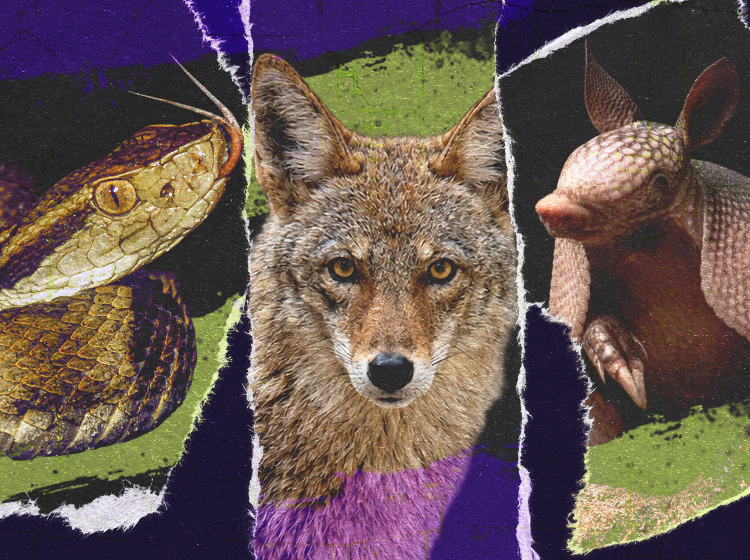
- The Wildlife Waste campaign: White Coat Waste (WCW) is exposing taxpayer-funded experiments on wild animals.
- Taxpayers are footing the bill: The National Institutes of Health, National Science Foundation, U.S. Department of Agriculture, National Hansen’s Disease Program and a growing list of others pour millions into grants, contracts, and labs to capture, breed, buy, sell, confine, experiment on, and kill wild animals.
- A nationwide network: Government and university labs run taxpayer-funded wildlife experiments across the country and ship animals nationwide and overseas.
- Generations of waste: Some captive colonies and experiment programs have been running on the taxpayer dime for more than 50 years, and they’re still going.
- Bringing the receipts: We’re following the money and uncovering the records these agencies would rather keep quiet.
White Coat Waste’s (WCW) Wildlife Waste campaign exposes a corner of government spending most taxpayers don’t know they’re paying for: experiments on wild animals.
Whether animals are taken from the wild, confined in labs, or bred in captivity, mammals, birds, reptiles, amphibians, and marine animals are caught in a web of grants, contracts, and labs that keeps experiments running for generations.
We’re exposing these wasteful labs one by one.
WCW Wildlife Waste Investigations
What has WCW uncovered about taxpayer-funded experiments on wild animals?
“Coyote Monogamy” Experiments
The United States Department of Agriculture’s (USDA) Predator Research Facility in Utah has captured, confined, and experimented on coyotes for more than five decades, including wild-born pups dug out of their dens. Records obtained by WCW reveal a National Science Foundation (NSF)-funded protocol that calls for using up to 78 captive coyotes from the USDA colony in “monogamy” experiments that include vasectomies, forced restraint, and brain-targeting drug injections. Researchers plan to kill coyotes’ mates, monitor the widowed survivors as they grieve, then kill the survivors too and collect their brains. NSF has awarded Utah State University $1,131,989 for the project, and the protocol runs through March 2030. WCW filed a lawsuit against NSF for failing to provide records sought in its February 2026, Freedom of Information Act (FOIA) request concerning the coyote monogamy experiments. [Read the investigation →]
$13 Million Viper Lab
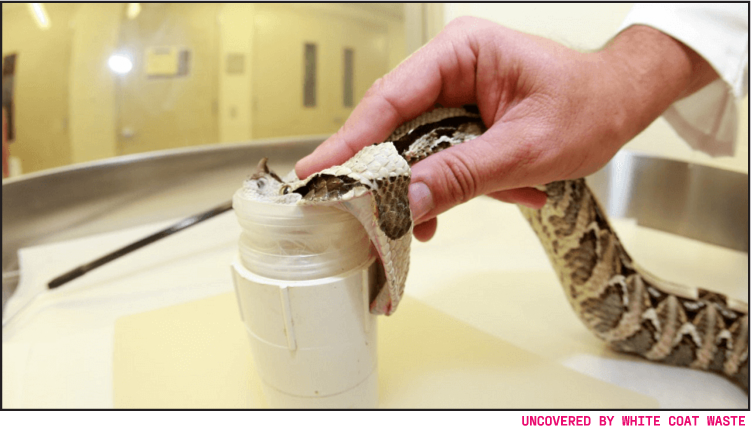
WCW uncovered more than $13 million in National Institutes of Health (NIH) funding for Texas A&M University–Kingsville’s Viper Resource Center, which captures wild snakes, breeds them in captivity, and supplies venom for animal experiments. Records obtained by WCW reveal a colony of more than 400 snakes, with plans to expand to approximately 700. The center repeatedly extracts venom, sells snake blood and tissues, and kills snakes to harvest their venom glands. WCW also traced its venom to experiments involving paralysis, internal bleeding, tissue damage, and lethal-dose testing on other animals. The center’s primary NIH grant is scheduled to continue through April 2029. [Read the investigation →]
Capturing Wild Armadillos for Leprosy Experiments
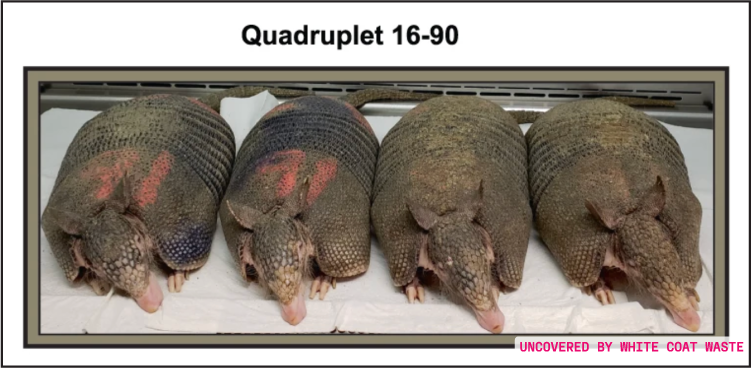
WCW uncovered a federal laboratory that has used armadillos in taxpayer-funded leprosy experiments for more than five decades. The National Hansen’s Disease Program (NHDP) uses wild-caught and captive-bred armadillos in experiments involving deliberate infection, electrical nerve stimulation, nerve severing, biopsies, drug testing, and killing. Federal contracts totaling more than $300,000 have supported armadillo capture and rearing at the University of the Ozarks, including a new February 2026 contract worth up to $183,000 extending through January 2030. NHDP receives approximately $13.7 million annually, a portion of which supports the armadillo experiments. [Read the investigation →]
NIH and NSF Fund Axolotl Breeding and Amputation Experiments
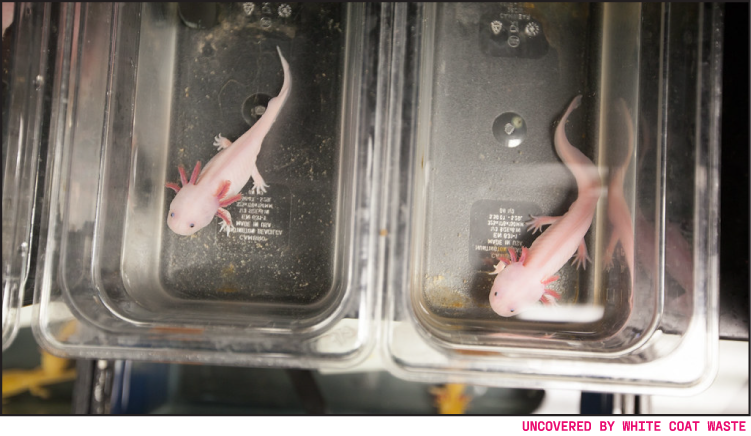
WCW uncovered more than 61 years of federal funding totaling at least $20.3 million for an axolotl breeding colony now housed at the University of Kentucky. The colony traces its origins to wild axolotls captured in Mexico more than 160 years ago. Records WCW obtained through FOIA show the colony maintains about 1,000 adults and nearly 4,000 juveniles and larvae and supplies labs worldwide. NIH and NSF have awarded millions more for experiments at Harvard, Northeastern, and University of Massachusetts, Boston that involve amputating limbs, severing nerves, implanting electrodes, and killing axolotls. WCW filed a formal complaint with NIH after finding that Harvard and Northeastern violated federal law by failing to fully disclose the amount of taxpayer funding behind their axolotl experiments. [Read the investigation →]
Is this how you want your money spent? The solution is simple: